Endodontics
Root canal treatment under the microscope in Schiedam and Rotterdam
Do you have dull or throbbing tooth pain, pain with hot or cold, or a sensitive spot on the gum? Then the nerve of a tooth or molar may be inflamed. At 3D Tandarts, we first examine the cause. Then we treat the root canal with a rubber dam and magnification, aiming to preserve your own tooth. If you have acute pain or a swollen cheek, call us immediately or consult Emergency Dentist.
What is a root canal treatment (endodontics)?
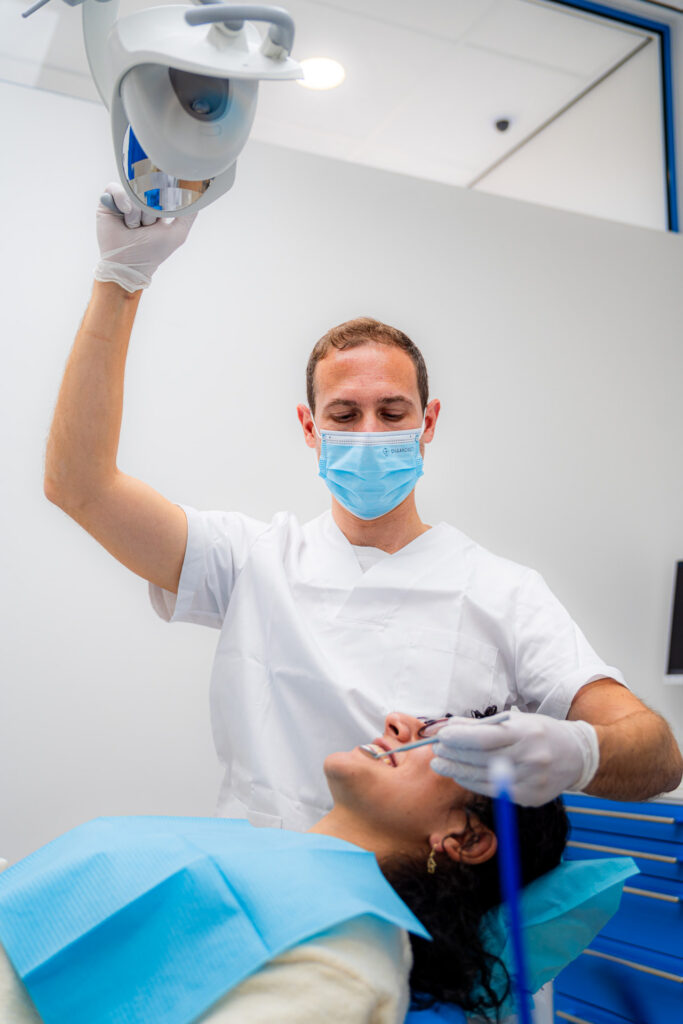
Inside every tooth is the nerve (the dental pulp), with blood vessels and nerve tissue. If this becomes inflamed or dies, for example due to a deep cavity, a leaking filling, a crack, or an impact, it does not heal on its own. In a root canal treatment (also called nerve treatment), the dentist removes the inflamed tissue, cleans the canals, disinfects them, and seals them. This can often preserve the tooth. Without treatment, the inflammation can spread to the bone around the root, causing more pain, swelling, and sometimes an abscess.
Does a root canal treatment hurt?
The treatment is performed under local anesthesia. We take the time to allow the anesthesia to work properly, and you can always ask for a break. You may feel pressure, but no sharp pain. The goal is precisely to eliminate the pain. Afterwards, the tooth may be sensitive for a few days. This can usually be managed well with regular painkillers.
How does the treatment proceed?
- Examination and diagnosis: examination of the tooth and an X-ray. In case of doubt or a complex situation, a CBCT scan (3D X-ray) can provide additional information.
- Anesthesia and rubber dam: a rubber sheet around the tooth keeps the working area clean, dry, and safe.
- Working under magnification: with a microscope, we accurately locate and follow even thin and curved canals.
- Cleaning and disinfecting: with fine files and a disinfecting rinse solution. In cases of complex or recurring infections, a diode laser can also be used.
- Filling the canals: the canals are completely filled to prevent new infection as much as possible.
- Restoration of the tooth: often first a temporary filling, then a permanent filling or crown. For molars, we often recommend a crown to prevent fracture.
When is a CBCT scan needed?
Usually, regular X-rays are sufficient. For complex root canals, persistent complaints, previous treatment, or unclear X-rays, a CBCT scan can help detect hidden canals, inflammation at the root tip, and cracks. We recommend this only if the additional information truly adds value.
One or multiple appointments?
Simple treatments are often completed in one appointment. Complex root canals, retreatments, or severe infections usually require two or more appointments. A treatment usually lasts 60 to 90 minutes per tooth. During the consultation, we discuss how many appointments are likely needed.
What does a root canal treatment cost in Schiedam?
The costs depend on the tooth, the number of canals, the complexity, and the number of appointments, according to NZa tariffs. For adults, a treatment usually costs between €400 and €1,000, excluding the final filling or crown. You will always receive a clear estimate beforehand. For children and adolescents under 18 with Dutch basic insurance, the treatment is in principle covered by the basic insurance.
When should you call immediately?
- Severe, throbbing toothache
- Pain when biting or chewing
- Prolonged sensitivity to hot or cold
- Swelling of the gums or cheek
- A pimple (fistula) on the gums
The earlier we treat, the greater the chance that the tooth can be preserved.
Why choose 3D Tandarts for your root canal treatment?
- Standard practice with rubber dam and magnification
- CBCT scan and laser where it helps
- Explanation in Dutch, English, and Italian
- Directly at NS station Schiedam Centrum, accessible from Rotterdam, Vlaardingen, Delft, and Maassluis
Carefully assessed
Focused on preserving your tooth
Magnification and modern diagnostics support precise treatment. We explain the findings, options and follow-up before treatment.
Our approach
A clear process
Digital diagnostics and modern techniques are used where appropriate. We explain each step before you make a decision together with the dentist.
What matters
- Careful examination before treatment
- Clear explanation of options and alternatives
- Planning tailored to your personal situation
Frequently asked questions
Root canal treatment
Is the tooth as strong after the treatment?
A treated tooth can be more vulnerable. That is why we often discuss a crown or a strong filling.
Will I have complaints after the treatment?
Mild pain or sensitivity when biting is normal during the first few days. If the pain gets worse, or you develop swelling or fever, please contact us.
Is a root canal treatment reimbursed?
For adults, this usually falls under the supplementary dental insurance. We provide a cost estimate in advance and are happy to think along with you.
Is a root canal treatment always possible?
That depends on the tooth and situation. The dentist will discuss what is possible after examination, including alternatives such as extracting the tooth.
Discuss your situation
Request an appointment. The dentist will assess which care suits your situation.